
Introduction
Located in the northwest of Rutland — England's smallest rural county — Whissendine is a village and civil parish home to approximately 1,300 people. Tucked away off all main roads, its residents enjoy the tranquility of beautiful rural surroundings with easy access to the market towns of Oakham and Melton Mowbray, both just five miles away.
On high ground at opposite ends of the village are two fine Grade I listed buildings which dominate the skyline: St Andrew's Church and Whissendine Windmill. Between them sits a mix of housing, from thatch and mud cottages to 21st-century conversions and new developments, with around 550 homes in total.


Key Facts
Population
-
1,300
Homes
-
550
County
-
Rutland
First recorded
-
Domesday Book, 1086
Name origin
-
Anglo-Saxon — Wyckinga's Den ("valley with a stream belonging to Wick's people")
Listed buildings
-
20
Grade I listed
-
St Andrew's Church, Whissendine Windmill
Scheduled Ancient Monument
-
Moor Lane — medieval moat, field system and trackways
Village History
Origins
01
Whissendine was first mentioned in the Domesday Book in 1086, recorded variously as Whichingendien, Wixenden, Wicsunden and Wissenden, though the first settlement was probably four to five hundred years earlier. The oldest part of the village grew up on high ground around the church and manor. There were once four manor houses — one of which had a round tower — though only one remains today. The footings of two others were uncovered during the last century; one now lies buried under Hall Close/Horton's Lane. The Whissendine Brook, from which the village takes its name, remains a central feature to this day.
The Harborough Era
02
In the early 19th century, Robert, 6th Earl of Harborough, owned the village and all the surrounding lands. After his death, the estate was split up in 1861 and the tenants had the opportunity to buy their own farms and cottages, bringing many new families into the village.
The navvy yard on Stapleford Road was built to house the men who constructed the railway. Twenty small houses were installed (of which four remain) and the railway opened in 1848, following a dispute between the Earl of Harborough — principal shareholder of the Melton Navigation Canal — and the Midland Railway.
Victorian Whissendine
03
The Methodist Chapel was built in 1868, and a Wesleyan Chapel stood on the Oakham Road before falling into disrepair and eventually being used as a builder's store. A further three chapels were situated on Stapleford Road, Ashwell Road and Main Street, the last of which stood on the site now occupied by the Village Hall. The King George V Memorial Hall itself was made possible by the generosity of Mr Frank Chaplin in 1937 and continues to serve the village today.
The same year as the Methodist Chapel — 1868 — the Rev EL Horne gave the school on the green, with its associated land, to the village. That school closed in 1970 when the new school opened further up Main Street, on the butcher's field opposite the Old Butcher's Shop.
St Andrew's Church
04
The church is one of the largest in Rutland. Its impressive 100-foot tower, built of Barnack stone, can be glimpsed across the rolling countryside from several miles away. The earliest parts date from the 13th century, with major building work in the 14th century doubling the height of the roof and adding the tower. A Victorian restoration was overseen by Sir Gilbert Scott. Notable features include numerous carved gargoyle heads and a medieval wooden screen originally from the old chapel of St John's College, Cambridge.
The history above is drawn from the Whissendine Village Design Statement.
Further Reading
To find out more about the history of Whissendine, see A History of the County of Rutland: Volume 2. Originally published by Victoria County History, London, 1935.
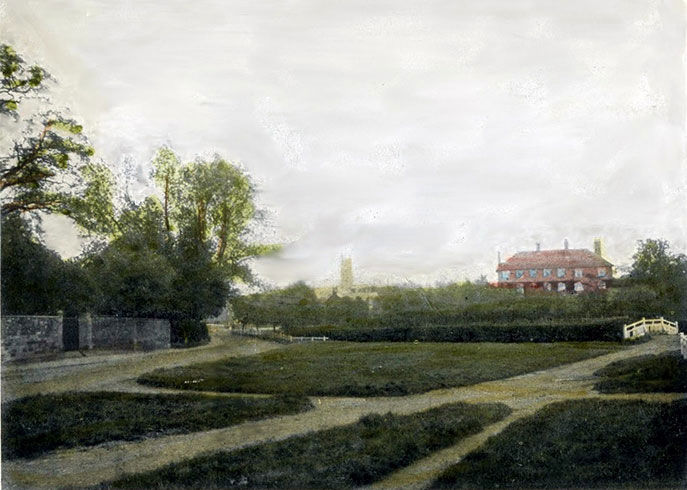
To the right, is a past photo of the Whissendine Village Green (unknown date). Photo courtesy of Pat Lake.
The Village Today
Whissendine is a sought-after village to live in. It has an outstanding primary school, a welcoming village pub, a well-stocked shop and post office, and one of England's few remaining fully operational 19th-century windmills. The village hall hosts everything from parish council meetings to amateur dramatics, and the sports club offers football, cricket, tennis, bowls and more.
Community life is strong. Feast Week — an annual celebration running for over 30 years — brings the village together every July with dozens of events across the week. There are active groups for all ages, from Brownies and Youth Group to the WI and Happy Circle. It's a village where people know their neighbours and get involved.


